


| 3. aettir | |
|
|
|
|
|
|
|
| 2. aettir | |
|
|
|
|
|
|
|
| 1. aettir | |
|
|
|
|
|
|
|
 The number of twigs on the left side of the stave indicate the aettir to which the rune belongs. The number of twigs on the right side of the stave indicates which rune it is in this aettir. The rune in this inscription will then be the 6th rune in the 2nd aettir. (However, in some cases may the reference to the rune and aettir be the other way round.)
 This is how a Futhark with younger runes will be if you count the attirs in their natural ranking.
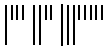 The long lines states in which aettir it's in. The short lines states in which succession the rune has in the prevailing aettir. The meaning of this inscription will then be the 3rd rune in the 1st aettir + the 2nd rune in the 2nd aettir + the 5th rune in the 3rd aettir.
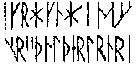
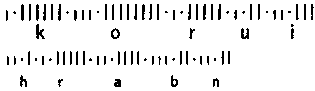 However, in some inscriptions the short lines is counted as the aettir and the long lines as the runes ranking in the aettir. The upper inscription (hand-written manuscript - St. Ggallen - Cod. 270 4to) is written in the Elder Futhark and fuþarkgw is counted as the 1. atttir. The lower
inscription is written with the younger runes and fuþark is counted as the 1st aettir.
However, in some inscriptions the short lines is counted as the aettir and the long lines as the runes ranking in the aettir. The upper inscription (hand-written manuscript - St. Ggallen - Cod. 270 4to) is written in the Elder Futhark and fuþarkgw is counted as the 1. atttir. The lower
inscription is written with the younger runes and fuþark is counted as the 1st aettir.
 The Vålsta stone's inscription, which is shown here, is more and less a summation of method 1 and 2, but principally the method is identical.
  This inscription is written on the Rök stone. The system is principally equally to the methods 1, 2 and 3. fuþark is counted as the 3. aettir.
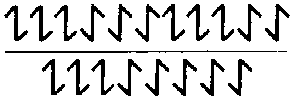 Another method of writing secret runes uses signs to indicate the rune and aettir. The number of left-turned signs gives the aettir and the following number of right-turned signs gives the ranking of the rune in the aettir. fuþark is counted as the 3. aettir. The upper line says þu and the lower line says r.
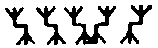 This way of writing secret runes is in principle equal to method 5.
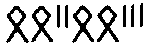 At first sight this inscription may look like that they have used an "o-rune" from the Elder Futhark and a "s-rune" from the Younger Futhark. It looks like the inscription says oossoosss
 Found among several runic inscriptions from the Middle Age found at Bryggen in Bergen there was a secret rune inscription using a man's head as the stave. The system of counting the Furhark's aettir and the ranking of the runes is in this case equal to all other above described ways of writing secret runes. This is a "S-rune", i.e. the 5. rune in 2. aettir.
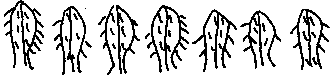 Also found among several runic inscriptions from the Middle Age at Bryggen in Bergen there is a secret runic inscription using a fish as the stave. The system of counting the Furhark's aettir and the ranking of the runes is in this case equal to all other above described ways of writing secret runes.
 Be aware of that runes like this which were written on the Klyver stone, should not be read as secret runes.
 raþe sa er kan namn orklaski
| Name of the Rune | ||||||
| The Jötunvillur code´s rune |
| Name of the Rune | |||||
| The Jötunvillur code´s rune |
| Name of the Rune | |||||
| The Jötunvillur code´s rune |
 r.a.þ.k.m.u:iiiiii:ssssss:tttttt:iiiiii:llllll

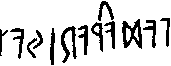 11111111u
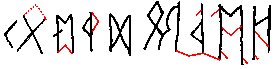 The runic inscription is approximately like this. The unbroken red lines are drawn as the twigs which are interpreted as "the irrelevant twigs". The broken red lines is drawn as the twigs which is interpreted as "the missing twigs". According to this theory we come to the following proposal to a left turned runic text:
 111heþro dweno k
