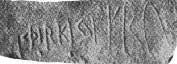
 111ek þirbijaR ru
 111keþan
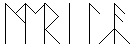 111ek erilaR

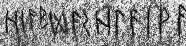 111hnabudas hlaiwa
 111haraRaR
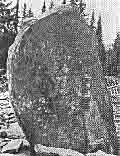 This rune stone is now located where it was found, approximately 250 m above the Slindrefjord in Valdres, Oppland. Along the mountain ridge there are several gravemounds. Although the rune stone is now standing upright, has it probably had been originally laying on a grave with the runic inscription downwards. The inscription is dated to the 300's AD, and is one of the oldest runic inscriptions in Scandinavia.
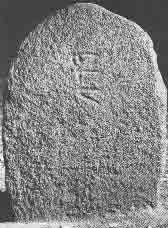 This rune stone was found in a gravemound at the Elgesem farm in Sandar, Vestfold. The inscription is written counter-clockwise and should be read from the top downwards. It is dated to the first part of 400's AD.
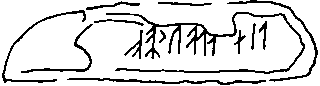 111lina laukaR f
 111gRu
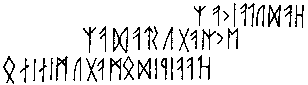
 111asugasdiR?lai??:
 111laiþigaR
 111ek gudija ungandiR and further ih or im
OPEDAL RUNE STONE
South-west of the Opedal farm in Ullensvang, Hordaland at Alavoll there are 5 big gravemounds. Approximately 20 m from the gravemounds the Opedal rune stone was found. The runes' design and language is nSl. and the inscription is dated to the beginning of the 400's AD.
The inscription has 34 runes and says:
Line 1: birgngguboroswestarminu
Line 2: liubumeRwage
There are several interpretation proposals. One of them is Birg, Inguboro, swestar minu liubu meR Wage which is translated "Help, Ingubora, my dear sister, me Wage."
Like other runic grave inscriptions, this inscription was not meant to be read by the living. It was written to protect the grave's peace and to secure the dead's favor for the survivors. Probably was this the help Wage wanted from his dead sister.
REISTAD RUNE STONE
The rune stone was found on the Reistad farm at the Hidra isle, Vest-Agder. The inscription has three lines where the runes are written clockwise. In accordance with the rune's design and the language the inscription is dated to the first half of the 500's AD.
Sophus Bugge reads the three lines:
Line 1: iuþingaR
Line 2: ik wakraR:unnam
Line 3: wraita
Line 1 is probably the name of the dead. Line 2 and line 3 can be translated "I (am) Wakr (I) know the art of writing" or "I (am) Wakr (I) did the writing".
ROSSELAND RUNE STONE
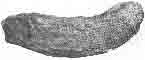 The fallos or sickle look-alike stone was found on the Rosseland farm at Norheimsund in Hardanger, Hordaland. It's nearly 1,5 m long, 40 cm on the widest and 25 cm on the thickest. The inscription is written in nSl. and the runes are written left turned. The inscription is dated to the 400's AD.
The inscription says: ek wagigaR irilaR agilamudon
After ek most often follows the rune-magician's name or the grade of his dignity, and because the inscription contains iralaR, wagigaR should be the runemaster's secular or religious name. According to the runic writing rules "n" should be left out before "d", and the next word agilamudon, might therefore be agilamundon which is the genitive of a woman's name *Agilamundo
The inscription might therefore be translated:
"I (am) WagigaR, (I am) Agilamundo's eril
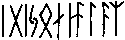 111igijon halaR
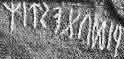 111widugastiR
 The inscription was found on the Tanem farm in Klæbu, South-Trøndelag.
 111...an: waruR
 111ekwiwaRafter`woduri
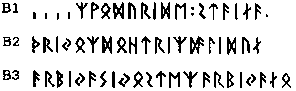 111????Rwoduride:staina:
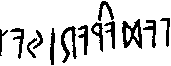 11111111u
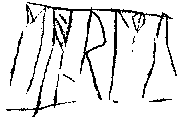
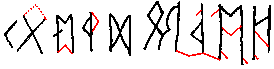 The runic inscription is approximately like this. The unbroken red lines are drawn as the twigs which are interpreted as "the irrelevant twigs". The broken red lines is drawn as the twigs which is interpreted as "the missing twigs". According to this theory we come to the following proposal to a left turned runic text:
 111heþro dweno k
 111ek irilaR wiwila
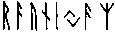 111raunijaR
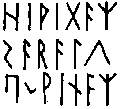
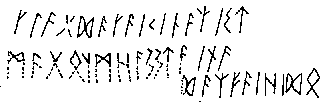
 The inscription has three lines, two long lines and one short line. The lower long line which is written clockwise should be read first, the upper long line which runs from the left to the right should be read second, and finally as the third, the short line between the two long lines and to the right of the horse figure. The short line is written upside down and left
turned.
The inscription has three lines, two long lines and one short line. The lower long line which is written clockwise should be read first, the upper long line which runs from the left to the right should be read second, and finally as the third, the short line between the two long lines and to the right of the horse figure. The short line is written upside down and left
turned.
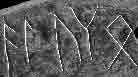 111aluko
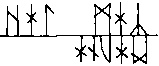 111hal maR (A1)
 111alunaalunana
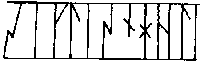 111The inscription says siklisnahli.
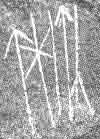 The stone was found on the Tveito farm in Tinn, Telemark, during archaeological diggings of two graves from the elder iron age, which looked like heaps of stones. The rune stone was lying upon one of the heaps. The finds in the tomb underneath the stone are dated to 400-450 AD, but the runic inscription on the rune stone cannot be so old. The runic inscription is dated to approximately 600 AD..
 111rhoaltR fai??
 The runic inscription is written in a vertical direction on a stone monument. The inscription on the Kuli stone from Smøla in Nordmøre, was written after the death of King Saint Olav.
 111litiluism
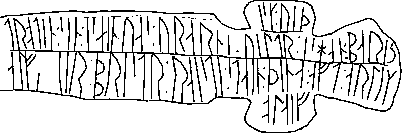 The Stavanger cross should, of course, stand upright. It is perhaps a monument stone for Erling Skjalgsson who fought against Olav Haraldsson at the Boknafjord the 21. December 1028 AD. According to Snorre one of Olav's men killed Erling after Erling had surrendered and Olav had promised him safe-conduct.
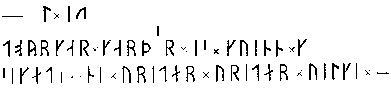 [--] t i u

 æirikar rit mer:runar
